Some people discover an artist they admire.
Others discover an artist who quietly follows them through life.
For me, that artist is Frida Kahlo.
Nearly thirty years have passed since I first walked through the gates of La Casa Azul in Mexico City, yet Frida’s story continues to find its way back into my life. In 2024, I listened to Mi Hermana Frida—in Spanish, of course—and found myself just as captivated as I was as a college student decades earlier.
The older I get, the more I find myself asking a simple question:
Why Frida?
Why has this Mexican artist stayed with me when countless other museum visits, books, and cultural experiences have faded into memory?
I think the answer has less to do with art and more to do with resilience, identity, and the unexpected ways people can shape our lives from across cultures, languages, and generations.
A Summer That Changed Everything
Almost thirty years ago, I was a college student double majoring in Spanish and English. During one unforgettable summer, I traveled to Mexico to participate in a language immersion program.
I lived with a Mexican host family, attended Spanish classes every weekday morning, and spent afternoons and weekends exploring the country. Like many study-abroad students, I arrived hoping to improve my language skills. What I didn’t realize was that Mexico would become the beginning of a lifelong love affair with Hispanic culture, language, and travel.
One of our excursions took us to Mexico City and La Casa Azul, the famous blue home where Frida Kahlo lived much of her life.
At the time, I knew Frida was important.
I had seen some of her paintings.
I knew she was considered one of Mexico’s greatest artists.
But I had no idea that nearly three decades later I would still be thinking about her.
The Room I Remember Most
If you asked me what I remember most about La Casa Azul, you might expect me to say one of her paintings.
It isn’t.
It’s the kitchen.
Nearly thirty years later, I can still picture the bright colors. The vibrant yellows. The deep cobalt blues. The rustic cookware hanging on the walls. Everything felt warm, inviting, and unmistakably Mexican.
Most museum rooms feel frozen in time.
Frida’s kitchen felt alive.
Standing there, I could almost imagine the room filled with people. Family members helping prepare a meal. Friends gathered around the table. Conversations flowing freely. Laughter echoing through the room. Music playing somewhere in the background. Maybe even a little dancing between stories and shared meals.
For a moment, it didn’t feel like a museum at all.
It felt like someone had simply stepped out of the room and would return at any minute.
Years later, when I think of La Casa Azul, that’s still what comes to mind.
Not a painting.
Not a souvenir.
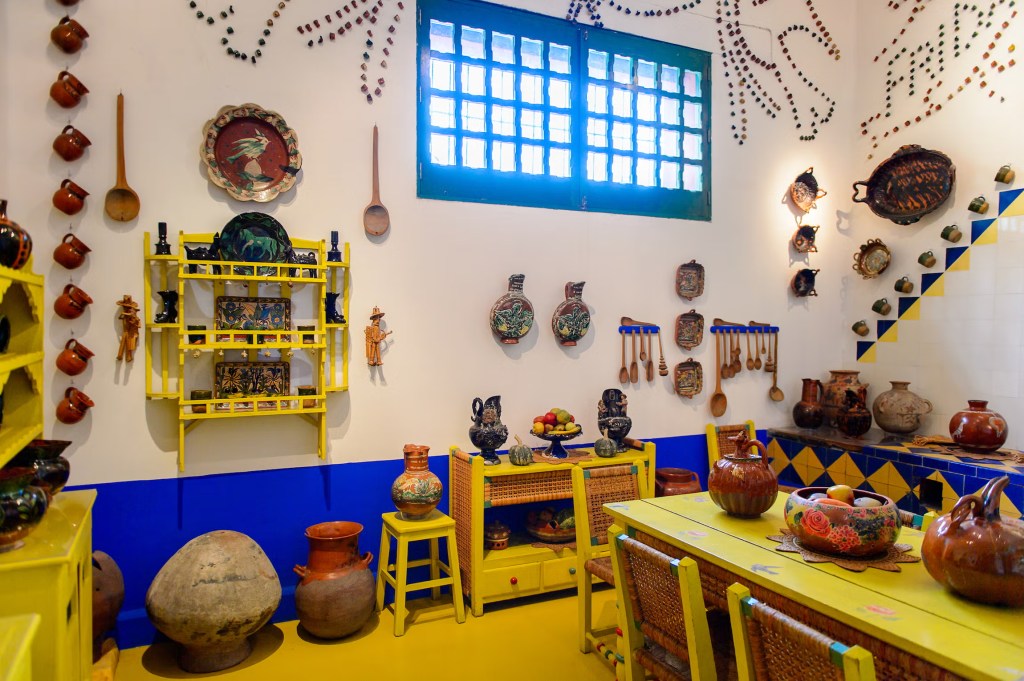
Nearly thirty years later, this is the room I remember most. The bright yellows, vibrant blues, and rustic charm made it feel less like a museum and more like a home waiting for its guests to return. I could almost imagine Frida laughing with friends around the table. Warm, colorful, and full of life—just like Frida herself.
That kitchen.
Warm.
Colorful.
Alive.
Just like Frida herself.
Trying to Understand Frida
When I first encountered Frida’s artwork, I wasn’t necessarily drawn to its beauty.
I was drawn to its mystery.
Her paintings were strange.
Powerful.
Sometimes unsettling.
They seemed filled with symbols and emotions I couldn’t quite decipher.
As a young college student, I found myself studying her paintings almost like puzzles. I wanted to know what she was trying to tell the world.
I wanted to understand her pain.
Her dreams.
Her fears.
Her hopes.
And perhaps most of all, I wanted to understand Diego Rivera.
The more I learned about Frida’s life, the more fascinated I became by her relationship with Diego. Here was a brilliant, talented, fiercely independent woman who loved a man who repeatedly betrayed her.
I couldn’t understand it.
How could someone so strong stay so devoted to someone who caused her so much pain?
Frida once described Diego as both the great love of her life and one of her greatest sources of suffering. That contradiction seemed to define so much of her story.
Back then, I didn’t fully understand it.
Life has a way of changing that.
As I’ve gotten older, I’ve learned that love is rarely as simple as it appears from the outside. Relationships are complicated. People are complicated.
And maybe that’s part of what keeps drawing me back to Frida.
She wasn’t perfect.
She didn’t pretend to be.
She loved deeply.
Sometimes painfully.
Sometimes irrationally.
Like so many of us do.
The Two Fridas
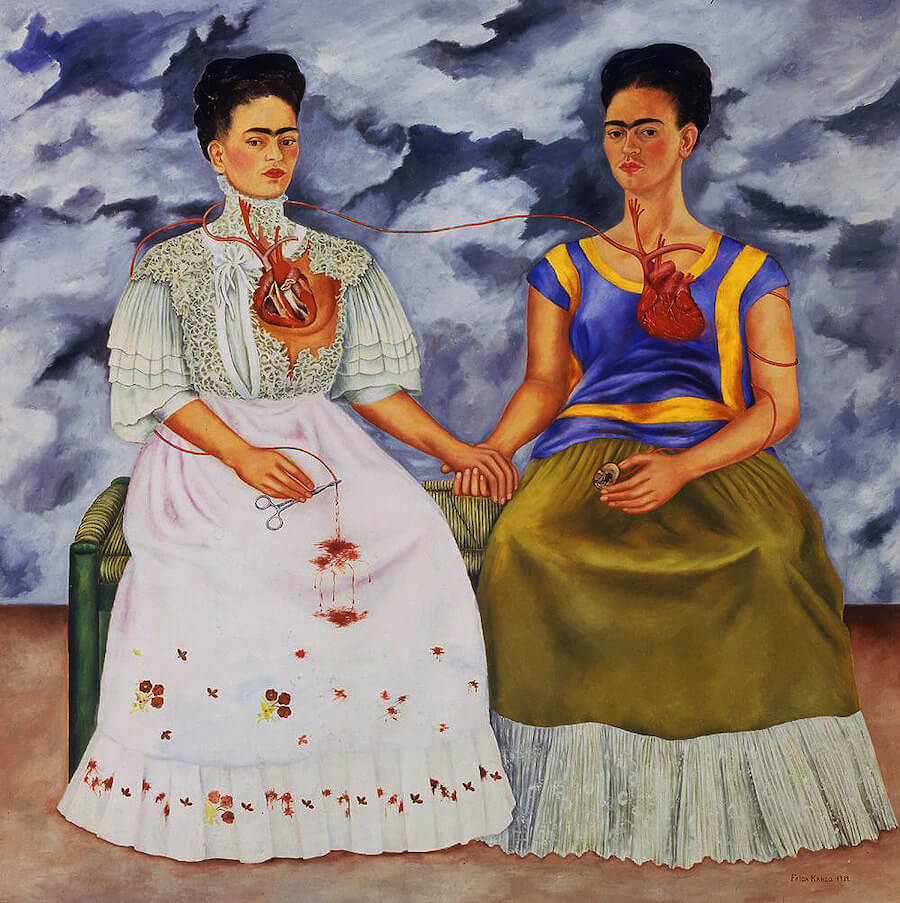
Some paintings are admired. Others are felt. For nearly thirty years, Frida Kahlo’s The Two Fridas has reminded me that identity is rarely simple. Between languages, cultures, and experiences, I’ve often felt like two versions of myself sitting side by side—different, yet connected. This painting continues to resonate with me in ways I never could have imagined when I first saw it as a college student. 🌺🇲🇽
Of all her paintings, The Two Fridas is the one that has stayed with me the longest.
When I first saw it, I was fascinated by its imagery.
Today, I see something much more personal.
As I’ve gotten older, there have been many times when I’ve felt like I existed between two worlds.
There is the Laura who grew up in a small town in Mississippi.
And there is the Laura who found a second home in the Spanish language and throughout Latin America.
The teacher.
The traveler.
The bilingual speaker.
The advocate for English Learners.
The woman who feels just as comfortable speaking Spanish as English.
Sometimes I have felt like two versions of myself sitting side by side.
Not in conflict.
But in conversation.
Much like Frida’s famous painting.
Perhaps that’s why it continues to resonate with me so deeply.
The Older I Get, the More I Admire Her
When I was young, I admired Frida’s art.
Today, I admire her resilience.
The older I get, the more I realize that Frida’s story is not really about suffering.
It’s about perseverance.
It’s about refusing to let tragedy define you.
It’s about creating beauty in the middle of heartbreak.
Frida endured physical pain that most of us can barely imagine. She survived a devastating accident, endured countless surgeries, experienced profound heartbreak, and lived with disappointments that would have broken many people.
One painting that affects me differently now than it did when I was younger is Henry Ford Hospital.
As a young woman, I understood the painting intellectually.
As a mother, I understand it emotionally.
Knowing how desperately Frida wanted children and how that dream was repeatedly taken from her makes the painting almost impossible for me to view without feeling a deep sense of sorrow.
Yet even in her grief, she created.
Even in her pain, she painted.
Even in her suffering, she lived.
And that resilience speaks to me.
My own life has not always been easy. Like many women, I’ve experienced heartbreak, disappointment, and challenges I never anticipated when I was young.
But Frida reminds me that difficult chapters do not have to be the end of the story.
Frida Found Me Again
In September 2022, I unexpectedly traveled to Buenos Aires, Argentina, as an International Powerlifting League referee for the IberoAmericano World Championship.
At the time, I had no idea that trip would open an entirely new chapter in my life.
That journey introduced me to lifelong friendships, deepened my connection to Latin America, and ultimately opened the door to future travels throughout South America.
Before leaving for Argentina, I discovered that a museum in Buenos Aires was hosting a Frida Kahlo exhibit on loan from Mexico.
Of course, I had to go.
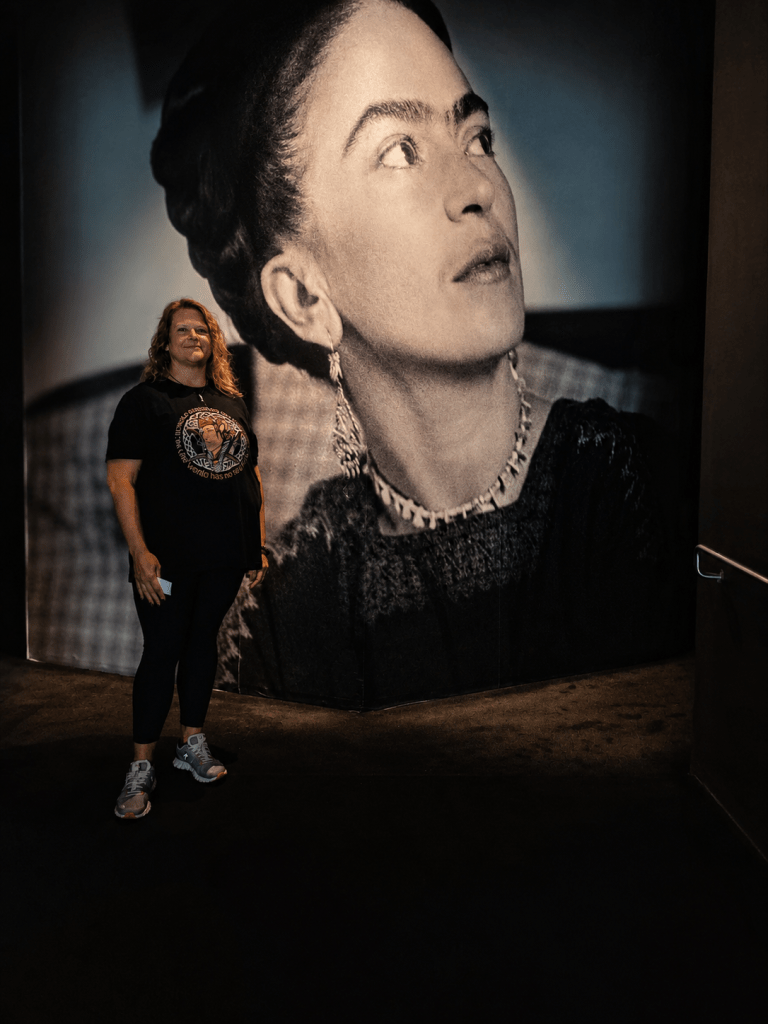
Standing in that museum nearly thirty years after my first visit to La Casa Azul felt surreal.
And somehow, Frida was waiting for me there.
What struck me most wasn’t even the artwork.
It was her handwriting.
There is something incredibly powerful about seeing a handwritten letter.
At some point, Frida sat at a table, picked up a pen, and poured her thoughts and emotions onto those pages.
Looking at those letters to Diego Rivera made her feel real in a way that paintings alone never could.
Not an icon.
Not a legend.
Not a museum exhibit.
A woman.
A complicated, passionate, resilient woman who loved fiercely and lived fully.
A Bridge
Over the past several years, I’ve come to think of myself as a bridge.
A bridge between languages.
Between cultures.
Between schools and families.
Between people who may not always understand one another.
Looking back now, I realize that Frida may have been one of the first bridges in my life.
Through her, I connected more deeply to Mexico.
Through Mexico, I connected more deeply to Spanish.
Through Spanish, I connected more deeply to people.
And through those people came friendships, opportunities, and experiences that have shaped who I am today.
Frida wasn’t simply an artist I admired.
She helped open a door.
And once that door opened, I never stopped walking through it.
Why Frida Still Matters
In 2024, I listened to Mi Hermana Frida in Spanish.
There was something fitting about revisiting her story in the language that has shaped so much of my adult life.
The same language that first brought me to Mexico.
The same language that has allowed me to connect with students and families.
The same language that has taken me across the Americas and introduced me to people I now consider family.
Nearly thirty years later, I am still captivated by Frida Kahlo.
Not because she was famous.
Not because she was talented.
But because she was authentic.
She lived on her own terms.
She embraced her identity.
She refused to let pain silence her.
And she created beauty from brokenness.
Coming Full Circle
Later this year, I will return to Mexico City for the first time in nearly thirty years.
Ironically, it is powerlifting that will bring me back once again, this time for the Meet of the Americas hosted by the IPL and Liga Mexicana de Powerlifting.
I plan to return to La Casa Azul.
This time, I’ll carry a digital camera instead of the 35mm film camera I used as a college student.
I’ll take new photographs.
I’ll make new memories.
But I suspect I’ll feel the same wonder I felt all those years ago.
Only now, I’ll carry with me three decades of experiences.
Three decades of travel.
Three decades of language learning.
Three decades of friendships.
Three decades of lessons.
And somewhere inside those bright blue walls, I have a feeling I’ll find Frida waiting for me once again.
Because some people leave fingerprints on our lives.
Nearly thirty years later, Frida Kahlo is still leaving hers on mine.
🌺 Have you ever encountered a book, artist, place, or person that quietly stayed with you for years—or even decades? I’d love to hear your story in the comments.
 Corazón Sin Frontereas
Leave a comment